
Settling After Half Term: Yoga and Mindfulness Tips for Schools and Nurseries
Feb 22, 2026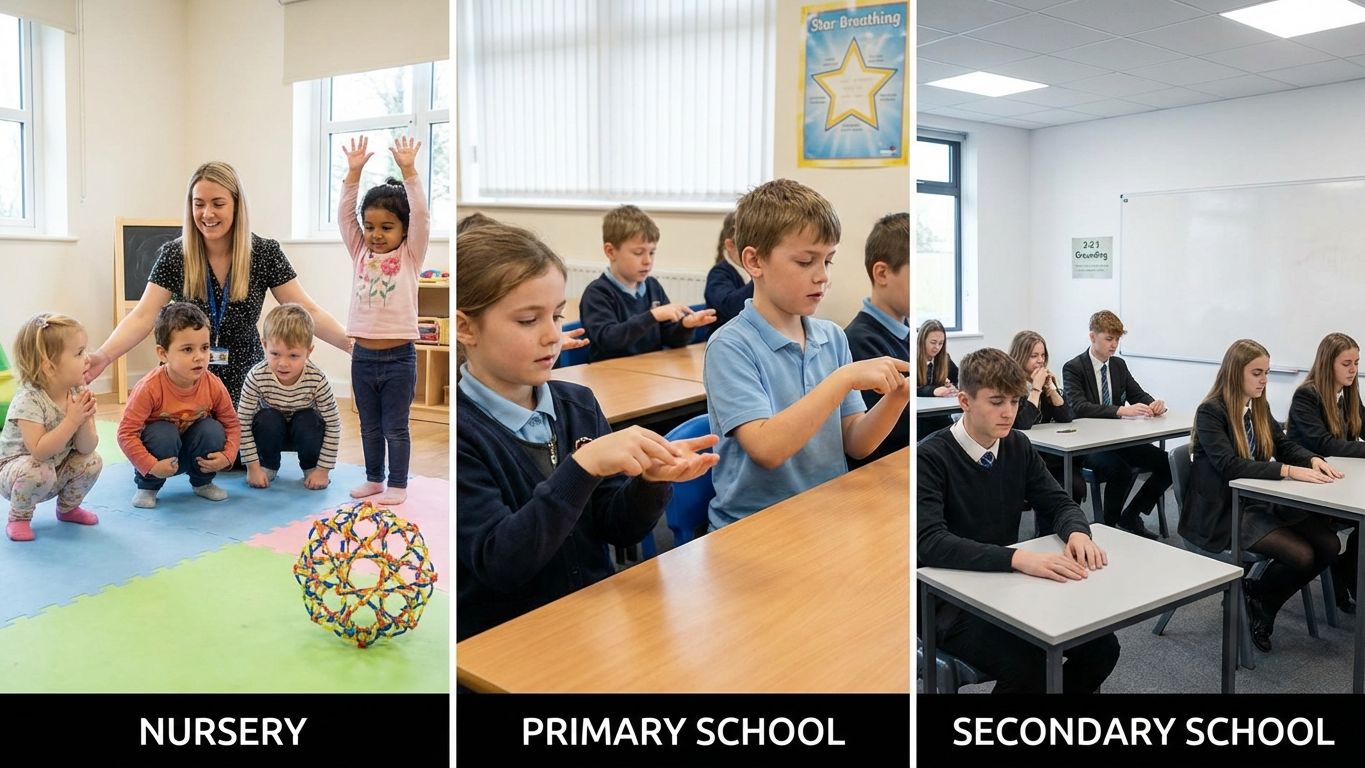
Returning to a routine after a half-term break can be a challenge for both staff and students. Whether in a nursery, a primary classroom, or a secondary school, the "re-entry" phase often brings a mix of excitement and dysregulation.
Integrating short, purposeful yoga and mindfulness practices can bridge the gap between home life and the learning environment. Here are three practical strategies to help your setting settle back into a productive rhythm.
1. Nursery and Early Years: The 'Little Seed' Breath
In Early Years settings, the return from half term often involves managing separation anxiety or a temporary loss of routine. According to the EYFS framework, supporting Personal, Social, and Emotional Development (PSED) is a priority.
The Practice: Seed to Flower
Ask the children to crouch down small like a tiny seed. Encourage them to breathe in slowly through their nose as they "grow" into a tall flower, reaching their arms up high. On the exhale, they gently fold back down to the floor.
Why it Works
Deep nasal breathing activates the parasympathetic nervous system. This helps to lower cortisol levels and move children out of a "fight or flight" state. For 2 to 5-year-olds, having a physical movement attached to the breath makes the abstract concept of "calming down" concrete and achievable.
How to Adapt It
-
For high energy: If the room feels chaotic, speed up the "growth" phase and then slow down the "folding" phase to settle them.
-
For SEN/ALN: Use a physical prop, like a Hoberman sphere or a silk scarf, to provide a visual cue for the breath.
2. Primary Schools: The 'Five-Finger Star' Focus
Primary-aged children often return with a lot of "social noise" - stories to tell and high energy to burn. Research by the Evidence Based Practice Unit suggests that school-based mindfulness can improve emotional regulation and classroom behaviour.
The Practice: Star Breathing
Children hold one hand out like a star. Using the index finger of the other hand, they trace the outline of their fingers. They breathe in as they slide up to the fingertip and breathe out as they slide down into the "valley" between fingers.
Why it Works
This practice uses "dual-focus" attention. By combining touch, sight, and breath, the brain is grounded in the present moment. It is an excellent tool for transitions, such as coming in from the playground or settling for a literacy block.
How to Adapt It
-
For KS1: Focus on the sensation of the finger on the skin.
-
For KS2: Challenge them to make each breath last exactly five seconds, building internal timing and focus.
3. Secondary Schools: The '3-2-1' Grounding Technique
Teenagers often return from break with "academic "re-entry" stress" or social media fatigue. Mental health statistics from the NHS indicate that roughly one in five young people aged 8 to 25 have a probable mental disorder. Providing them with "invisible" tools is essential for their autonomy.
The Practice: 3-2-1 Grounding
This is a silent, desk-based mindfulness exercise. Ask students to sit comfortably and mentally note:
-
3 things they can see in the room.
-
2 things they can feel (feet on the floor, the chair against their back).
-
1 thing they can hear.
Why it Works
This technique interrupts "rumination"—the repetitive loop of stressful thoughts about exams or social issues. By engaging the senses, it anchors the student in the physical safety of the classroom, making them more available for learning.
How to Adapt It
-
In PE or Drama: Perform the exercise standing up, focusing on the sensation of the feet to build physical stability.
-
Before Exams: Encourage students to use this secretly at their desks to lower heart rates before the paper starts.
Supporting Your Professional Development
Implementing these tools is most effective when staff feel confident in their own practice. If you are looking to deepen your impact and bring these benefits to your setting on a permanent basis, our accredited training courses provide the skills you need.
-
Early Years Yoga: Perfect for nursery practitioners looking to lead structured wellbeing sessions.
-
Children’s Yoga (Ages 5 to 11): Ideal for primary teachers wanting to integrate movement into the curriculum.
-
Teen Yoga: Designed for secondary staff and youth workers to support adolescent mental health.
Learn more about the course here: www.beam.academy
Sign Up For Our Monthly Newsletter
Receive monthly emails with news, blogs and articles about teacher training courses, yoga, mindfulness, education and so much more.
We hate SPAM. You'll only get quality content.
