
How short movement breaks can help primary pupils refocus in class
Oct 05, 2026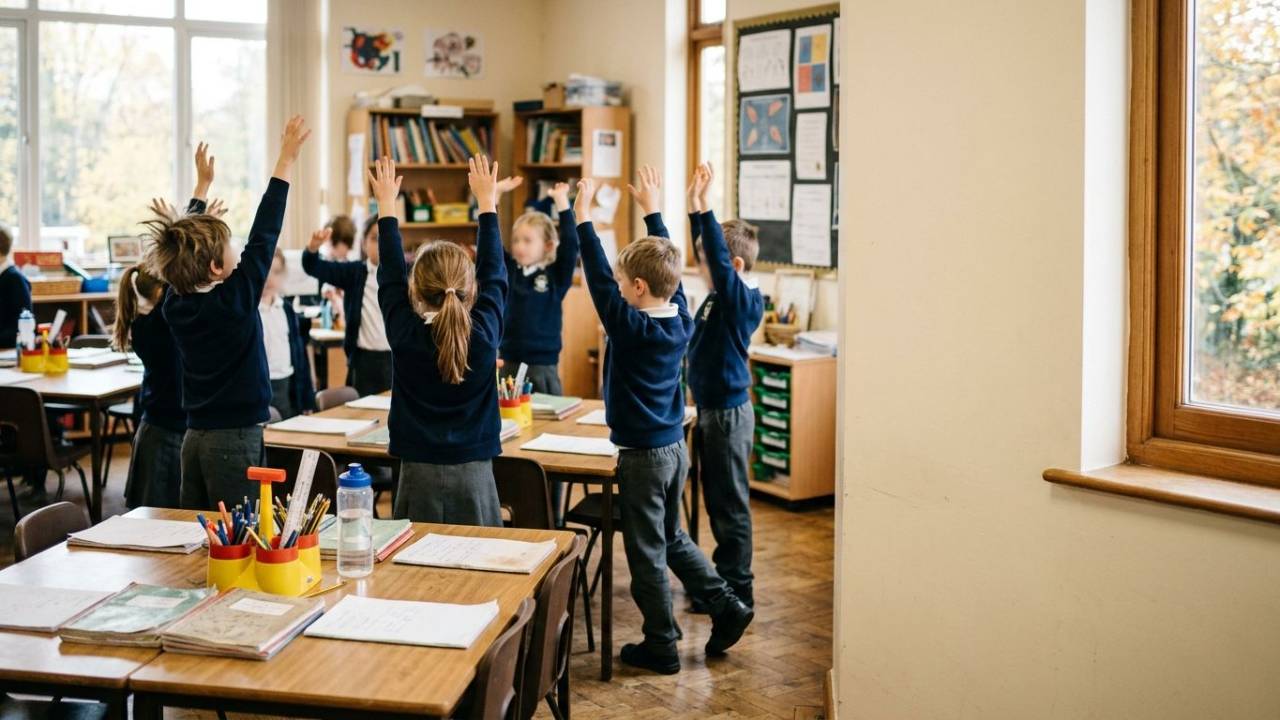
Anyone who has taught a Year 4 class at 2pm on a wet Tuesday knows the look. Pencils are being chewed, chairs are tipping back, and the fractions on the board might as well be in another language. Often the problem isn't the lesson. It's that children have been sitting still for longer than their bodies are built for.
The good news is that a few minutes of the right kind of movement can help, and it doesn't need a hall, any kit or a PE specialist. Here's what the evidence says, plus some simple ideas you can try in your classroom this week.
What the new activity guidelines say about sitting
In July 2026 the UK Chief Medical Officers refreshed the national physical activity guidelines, with the message that every movement counts. The targets for children haven't changed: children and young people aged 5 to 18 should average at least 60 minutes of moderate-to-vigorous activity a day across the week.
The guidelines also say children should "aim to minimise the amount of time spent being sedentary" and, when they can, "break up long periods of not moving with at least light physical activity". That line matters for schools. A typical primary day includes plenty of time at tables, and light activity counts. A stretch, a few standing poses or a minute of marching on the spot is exactly the kind of thing the guidance has in mind.
How active are primary children right now?
Sport England's latest Active Lives Children and Young People Survey (academic year 2024/25) found that 49.1% of children in England meet the 60-minute guideline. That still means around half of children are falling short, and 28.4% are classed as less active, doing under 30 minutes a day on average.
The same survey links activity with how children feel. Active children gave an average happiness score of 7.1 out of 10, compared with 6.7 for less active children, and they were more likely to strongly agree that they keep going when things get difficult (38% compared with 29%). These are associations rather than proof that activity causes the difference, but they point in a hopeful direction.
Does moving in class help with focus?
This is the question teachers usually ask, because the timetable is already full. A systematic review and meta-analysis by Watson and colleagues, published in the International Journal of Behavioral Nutrition and Physical Activity, looked at classroom-based physical activity for primary-aged children. Across the studies that could be combined, classroom activity improved on-task behaviour and reduced off-task behaviour.
It's fair to say the picture isn't simple. A University of Stirling and University of Edinburgh study of around 6,000 Scottish pupils aged 9 to 11 taking part in running programmes such as The Daily Mile found a small link between fitness and memory in children who had been taking part for a shorter time, but no longer-term benefit for thinking skills or wellbeing. Importantly, the researchers also found no substantial negative impact from using that class time to move.
So movement breaks aren't a magic fix. They're a low-cost way to give children's bodies what they need, and many pupils find it easier to settle back into learning afterwards.
Why yoga-style breaks suit the classroom
Not every movement break suits every moment. A lap of the playground before a spelling test might leave a class more excited than focused. Yoga-based breaks mix movement with slower breathing and a clear finish, so children get the stretch without losing the calm.
- Tiny space: most poses can be done standing beside a desk.
- Inclusive: poses are easy to adapt for children who use wheelchairs, prefer to stay seated or need extra support.
- Language-light: showing a pose works well for children learning English as an additional language.
- A built-in landing: ending with a few slow breaths helps the class move from "up" back to "ready".
Five classroom breaks to try this week
None of these need equipment, and each takes two to four minutes.
- Tall tree, wobbly tree. Children stand, reach their arms up and grow as tall as they can, then try balancing on one foot (or keep their toes on the floor). Laughing about the wobbles is part of it.
- Seated sun stretch. Reach up high, fold forward over the knees, then roll back up slowly. Repeat three times, moving with the breath.
- Weather report. March on the spot for a storm, slow to a gentle jog for rain, then stand still for sunshine and take three slow breaths.
- Surprised shoulders. Shrug the shoulders up to the ears as if surprised, then drop them with a big sigh. Lovely after a stretch of handwriting.
- Five-finger breathing. Trace up and down the fingers of one hand with the other, breathing in on the way up and out on the way down. A calm finish to any of the above.
Two tips from how we plan sessions: use the same short signal each time (a chime or a clap pattern) so children know what's coming, and always finish with something still. The ending is what helps the class return to learning.
Making it part of the school day
Movement breaks tend to stick when they're part of the routine rather than a reward. Some schools tie them to natural transition points, such as after lunch, between maths and English, or before an assessment. Others take a whole-school approach, so teachers, teaching assistants and lunchtime staff all use the same language and the same few routines.
At BEAM ACADEMY, our yoga and mindfulness sessions for primary schools are designed with this in mind. Children learn the poses and breathing in a regular session, and staff come away with simple routines they can reuse in class in between. For staff who'd like to go further, our children's yoga teacher training covers how to plan and lead sessions with confidence.
Thinking about younger children too? Our recent post on school readiness and what nurseries can do looks at the early years side of the same picture.
A quick note: movement breaks support general wellbeing, but they aren't a treatment for any condition. If you're worried about a child's mental or physical health, talk to your SENCO or mental health lead, and encourage the family to speak to their GP.
Want to bring calm movement into your school?
If you'd like to talk about how yoga and mindfulness could fit into your timetable, we'd love to hear from you. Email schools@beam.academy or get in touch through beam.academy.
Sources:
- New UK CMO activity guidelines show every movement counts (GOV.UK, 10 July 2026): https://www.gov.uk/government/news/new-uk-cmo-activity-guidelines-show-every-movement-counts
- UK Chief Medical Officers' physical activity guidelines (GOV.UK, updated 10 July 2026): https://www.gov.uk/government/publications/physical-activity-guidelines-uk-chief-medical-officers-report/uk-chief-medical-officers-physical-activity-guidelines
- Children's activity levels rising, but inactivity remains too high (Sport England, 4 December 2025, Active Lives CYP 2024/25): https://sportengland.org/news-and-inspiration/childrens-activity-levels-rising-inactivity-remains-too-high
- Watson et al., Effect of classroom-based physical activity interventions on academic and physical activity outcomes: a systematic review and meta-analysis (IJBNPA, 2017): https://researchnow.flinders.edu.au/en/publications/effect-of-classroom-based-physical-activity-interventions-on-acad/
- Daily activity is route to a better memory as well as fitness for pupils (University of Stirling, April 2022): https://www.stir.ac.uk/news/2022/april-2022-news/daily-activity-is-route-to-a-better-memory-as-well-as-fitness-for-pupils/
Sign Up For Our Monthly Newsletter
Receive monthly emails with news, blogs and articles about teacher training courses, yoga, mindfulness, education and so much more.
We hate SPAM. You'll only get quality content.
