
1 in 5 Children Now Have a Probable Mental Health Disorder, Here's What Eight Quiet Minutes a Day Can Do About It
Sep 20, 2026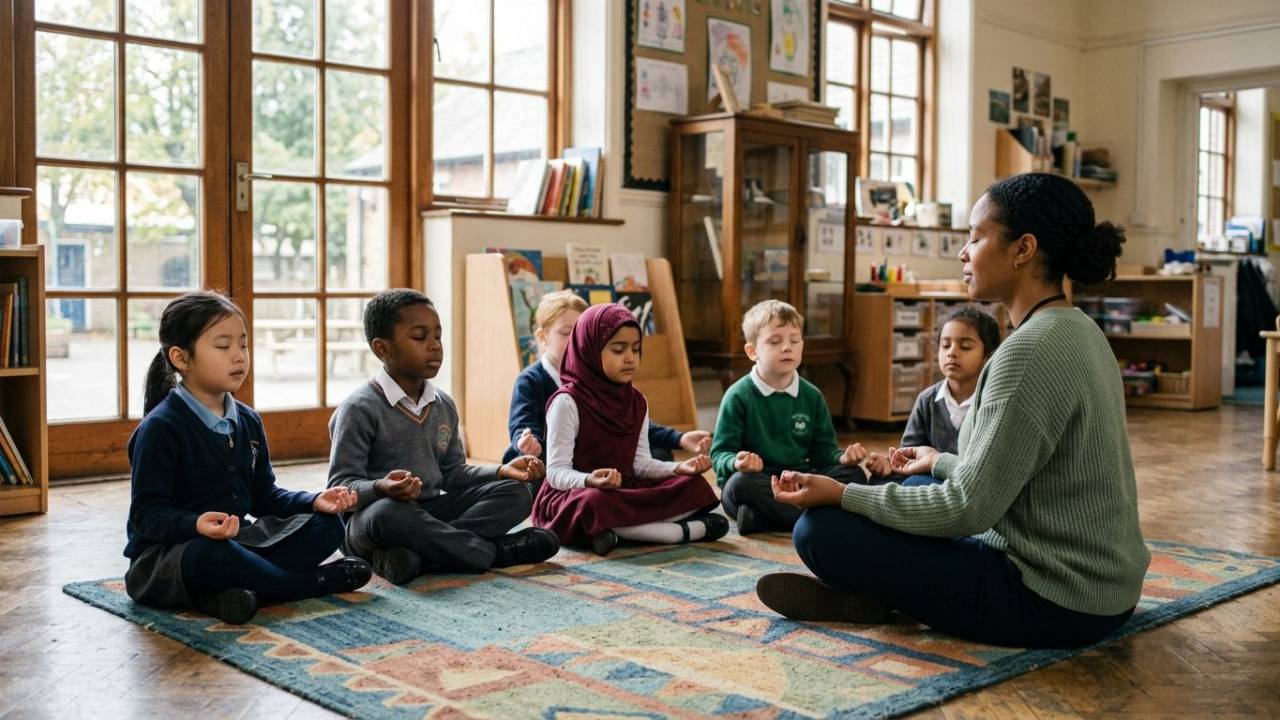
Today is International Day of Peace. The United Nations has marked it every year since 1981, and this year's theme is "Invest in Peace, for Everyone, Everywhere, Every Day." It's easy to read that as something for governments and diplomats. But peace, at its most basic, starts somewhere much smaller: a child's nervous system, on an ordinary Monday morning, in an ordinary classroom.
That's not a small thing. NHS England's most recent national survey found that 20.3% of 8 to 16-year-olds in England had a probable mental disorder in 2023, a figure that has held at roughly one in five since 2020, having risen sharply from one in nine in 2017. Put plainly, in a class of 30, that's around six children carrying a level of anxiety or low mood serious enough to meet clinical thresholds, alongside the many more who are simply stressed, overstimulated, or struggling to self-regulate on any given day.
Schools are not equipped to solve a national mental health picture on their own, and we'd never suggest otherwise. But there is a growing, credible body of research on what genuinely helps inside the school day, and it's smaller and more achievable than people expect.
A Tulane University study worked with third-graders showing signs of anxiety, giving one group eight weeks of short daily yoga and mindfulness sessions alongside their usual support, while a control group continued with standard care. The children who took part in the sessions showed significantly greater improvement in emotional wellbeing than those who didn't. Other research on mindfulness-based approaches in schools points the same way: modest, consistent practice is linked to better attention, calmer transitions between lessons, and children who are better able to name and manage what they're feeling rather than acting it out.
None of this is about turning every child into a yoga expert, and it's worth being honest that not every mindfulness programme delivers results at scale; larger trials have shown mixed effects depending on how well a programme is delivered and how consistently it's practised. The detail that matters is consistency and quality of delivery, not novelty. A well-run eight-minute session, three or four times a week, taught by someone who knows how to read a room of five-year-olds or a room of fifteen-year-olds, tends to do more than an occasional one-off assembly.
That's really what International Day of Peace should mean for a school. Not a single themed lesson that's forgotten by lunchtime, but a nudge to ask: what does our setting actually do, day to day, to help children come back to a calmer baseline? Where SEN and EAL pupils need it, are there different ways in for children who find sitting still or verbalising feelings hard? And are staff, who are absorbing a lot of this pressure themselves, getting anything back for their own regulation, not just the children's?
If your setting doesn't already have a rhythm for this, today is as good a day as any to start one. It doesn't need to be complicated. It needs to be regular, well taught, and genuinely built around the children in front of you rather than a generic script.
If you'd like to talk through what a realistic, term-long version of this could look like for your nursery, school or SEN setting, we're always glad to have that conversation.
Sources: NHS England, Mental Health of Children and Young People in England, 2023 (published 21 November 2023); Bazzano et al., Tulane University, presented at the Society of Behavioral Medicine's Annual Meeting; United Nations, International Day of Peace 2026.
Sign Up For Our Monthly Newsletter
Receive monthly emails with news, blogs and articles about teacher training courses, yoga, mindfulness, education and so much more.
We hate SPAM. You'll only get quality content.
