
How can a two-minute breathing routine help Year 11s through mock exams?
Oct 12, 2026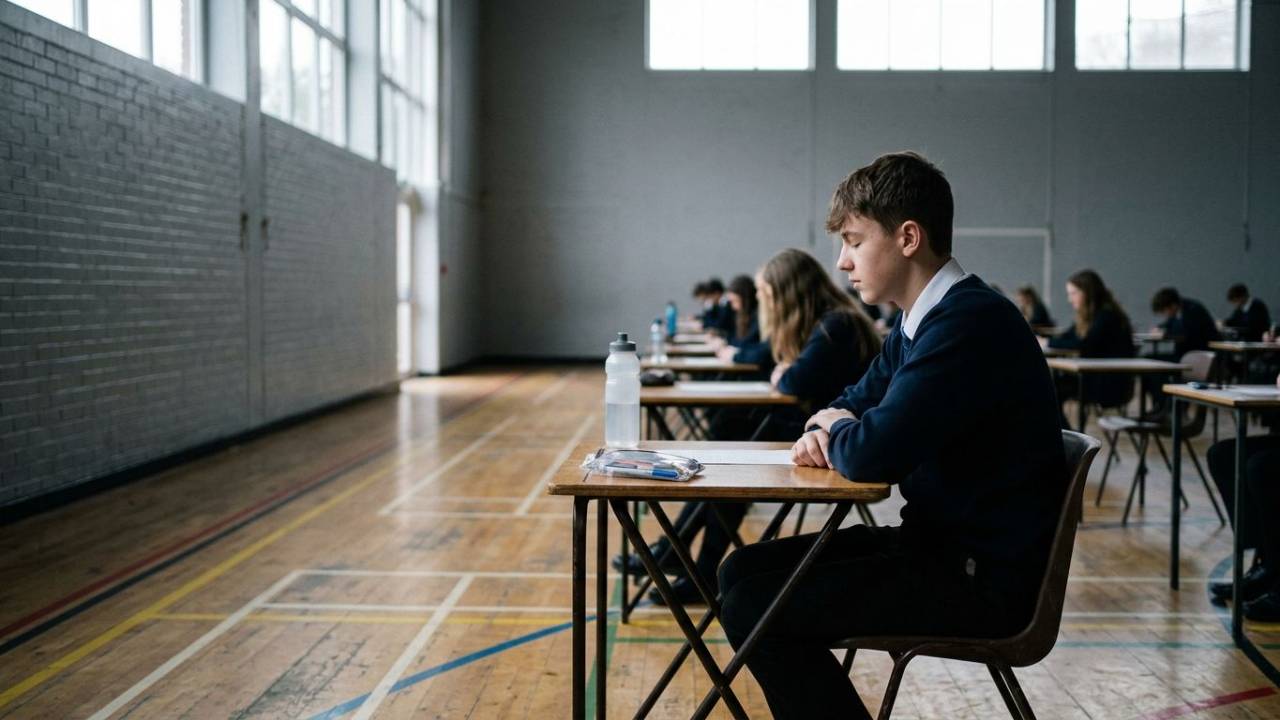
Mock season is nearly here. In many schools, November and December bring Year 11's first full run of GCSE-style papers in a proper exam hall, with invigilators, seating plans and that very particular silence. For lots of students it's useful practice. For some, it's the moment exam nerves first show up properly.
This post is for form tutors, heads of year and pastoral leads who'd like one small, practical thing to offer students before they turn over the paper: a simple two-minute breathing routine, plus some honest notes on the evidence.
Why mocks are a good time to practise
Exam stress tends to peak later in the year. Childline delivered 1,647 counselling sessions mentioning exam or revision stress between April 2024 and March 2025, with 359 in May alone. Where age was known, half of those sessions were with 12 to 15-year-olds.
Teachers see it too. In a 2024 Teacher Tapp survey for ASCL, 77% of secondary teachers said they had seen mental health issues linked to exam anxiety among their Year 11s, and 47% had seen students arriving at or leaving the exam hall in distress.
That makes mocks a gift, in a way. They're a lower-stakes rehearsal, and a calming technique tried for the first time on the morning of a real GCSE paper is far less likely to stick than one students have already used several times in November.
What the research suggests
We like to be careful here. Breathing exercises aren't magic, and they aren't a treatment for anxiety. That said, there is some encouraging research.
A study by Kenny Khng at Singapore's National Institute of Education, published in Cognition and Emotion in 2017, found that a short deep-breathing exercise before a test reduced test anxiety among primary pupils, and linked deep breathing to better attentional focus and maths test performance. The study also included a group of lower secondary students.
A 2023 Stanford study in Cell Reports Medicine found that adults who spent five minutes a day on "cyclic sighing" (a breathing pattern with a longer out-breath) for a month saw greater improvements in mood than a group who practised mindfulness meditation. That study was with adults, not teenagers, so we treat it as a helpful pointer rather than proof for the exam hall.
The common thread is that slow breathing with a longer out-breath seems to help the body shift down a gear. That's the bit we build on.
The two-minute routine
This works at an exam desk, in the queue outside the hall or at the start of form time. No mats, no music, no props.
1. Feet and seat (15 seconds)
Feet flat on the floor, roughly hip-width apart. Notice the chair holding you up. Hands rest on the desk or in your lap.
2. Soft gaze (15 seconds)
Close your eyes, or look down at a single spot on the desk. Keeping eyes open is completely fine.
3. Longer out-breath (60 seconds)
Breathe in through the nose for a count of four. Breathe out gently through the mouth for a count of six, as if cooling a hot drink. Repeat about six times. If four and six feel too long, try three and five. Nobody should feel strained or light-headed. If they do, they simply go back to normal breathing.
4. One steady sentence (15 seconds)
Silently say something calm and true, such as "I've prepared what I can" or "One question at a time".
5. Look up and begin (15 seconds)
Open your eyes, notice three things in the room, then pick up the pen.
For students who want to practise at home, the NHS has a longer version on its breathing exercises for stress page: breathe in for a count of up to five, out for a count of up to five, and keep going for at least five minutes.
Making it part of mock season
A routine works best when it feels familiar. A few ideas for tutor teams:
- Practise in form time first. Run it once or twice a week in the fortnight before mocks, so students already know the steps.
- Use the same words every time. A consistent script means students don't have to think. They just follow.
- Let invigilators know. A quiet "you can take a minute to breathe before you start" from a familiar adult can make the hall feel less daunting.
- Join in. Teenagers are quick to spot when something is being done to them rather than with them. Staff taking part makes it normal (and plenty of staff find it useful too).
- Keep it optional. Some students will get stuck in, others will sit quietly. Both are fine.
Don't forget sleep
Breathing helps in the moment, but rest does the heavy lifting. NHS England's 2023 survey of children and young people's mental health found that 37.8% of 8 to 16-year-olds had a problem with sleep on three or more of the previous seven nights. During mocks, it's worth reminding students (and parents) that late revision that eats into sleep is usually a poor trade. The longer NHS exercise makes a nice bedtime wind-down.
When to look further
Most exam nerves are normal and fade once the paper is done. But if a student is regularly too anxious to come in, isn't sleeping or eating well, or seems persistently low, a breathing routine isn't enough on its own. Speak to your school's pastoral or safeguarding lead, and encourage families to talk to their GP. Childline (0800 1111) is also there for young people who'd like to talk to someone outside school.
Where we come in
At BEAM ACADEMY we run yoga and mindfulness sessions for secondary schools across London, either embedded in the timetable or as clubs. Sessions are adapted for SEND and EAL learners, and we always aim to leave staff with simple tools, like this routine, that they can keep using long after a session ends. For how short breathing practices can support behaviour across the school day, see our post on how ten minutes of breathwork can change a student's day.
Some schools prefer to build this in-house. If someone on your team would like to lead sessions themselves, our teen yoga teacher training is designed for exactly that.
If you'd like to talk about support for Year 11 this mock season, get in touch at schools@beam.academy or via beam.academy. We'd love to hear from you.
Sources:
- NSPCC, "Rise in calls to Childline about exam and revision stress during the exam period last year" (30 April 2025): https://www.nspcc.org.uk/about-us/news-opinion/2025/rise-in-calls-to-childline-about-exam-and-revision-stress-during-the-exam-period-last-year/
- ASCL, "ASCL survey reveals alarming levels of exam anxiety among GCSE students" (Teacher Tapp, August 2024): https://www.ascl.org.uk/GCSEsurvey
- Khng, K. H. (2017), Cognition and Emotion 31(7), 1502-1510, summarised by NIE Singapore, "Deep breathing": https://singteach.nie.edu.sg/2021/04/22/deep-breathing/
- Balban, M. Y. et al. (2023), "Brief structured respiration practices enhance mood and reduce physiological arousal", Cell Reports Medicine: https://pmc.ncbi.nlm.nih.gov/articles/PMC9873947
- NHS, "Breathing exercises for stress": https://www.nhs.uk/mental-health/self-help/guides-tools-and-activities/breathing-exercises-for-stress/
- NHS England, "Mental Health of Children and Young People in England, 2023, Part 2: Sleep, loneliness, activities and health behaviours": https://digital.nhs.uk/data-and-information/publications/statistical/mental-health-of-children-and-young-people-in-england/2023-wave-4-follow-up/part-2-sleep-loneliness-activities-and-health-behaviours
Sign Up For Our Monthly Newsletter
Receive monthly emails with news, blogs and articles about teacher training courses, yoga, mindfulness, education and so much more.
We hate SPAM. You'll only get quality content.
