
Five ways to make a calm break predictable for pupils with SEND
Oct 17, 2026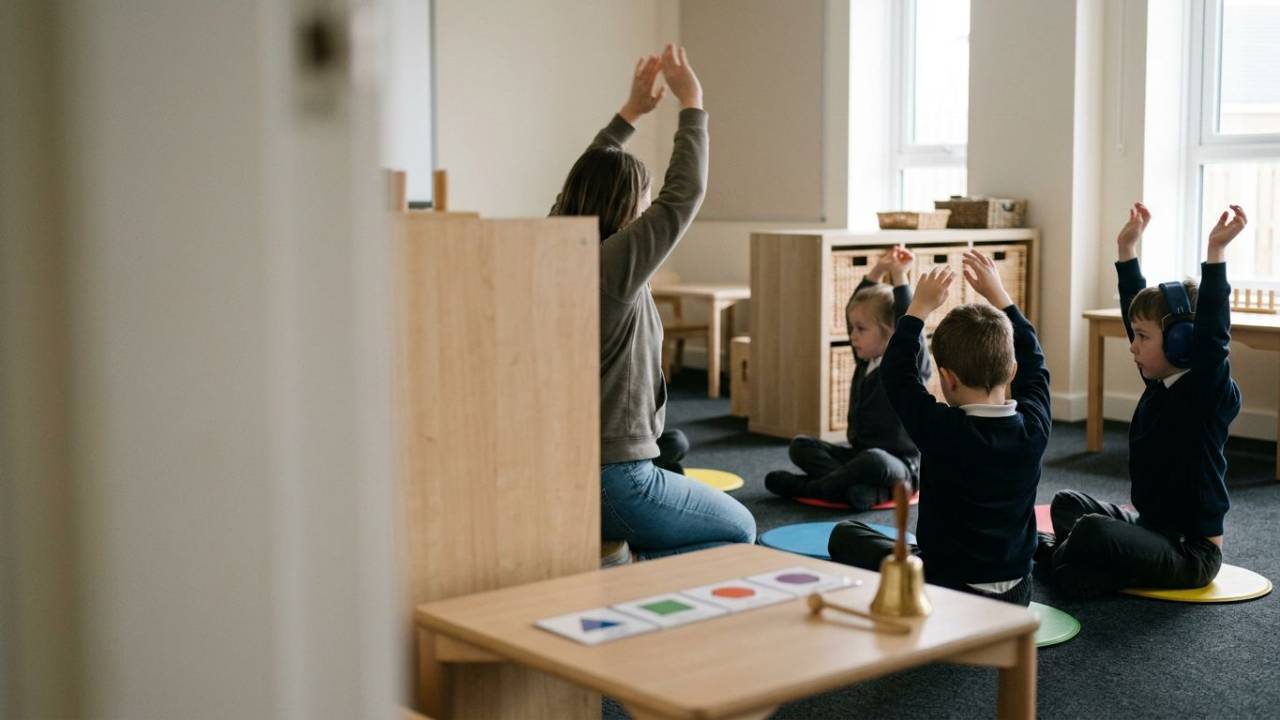
Ask any SEN teacher what makes a calm moment actually work, and you'll rarely hear "the perfect breathing exercise". You're far more likely to hear something about routine. Children who find the school day unpredictable often can't settle into anything new, however gentle it is, until they know what's coming and when it ends.
That's the idea behind this post. Rather than adding another activity to the day, we look at how to wrap the calm breaks you already use in a structure that pupils can trust.
Why predictability matters so much
The number of children this affects keeps growing. The Department for Education's latest figures show that over 1.8 million pupils in England have special educational needs, with 6.0% of pupils now holding an EHC plan (up from 5.3% a year earlier). Autism is the most common primary need among pupils with EHC plans, at 33.5%, and speech, language and communication needs are the most common among pupils on SEN support, at 25.7% (DfE, Special educational needs in England 2025/26).
For many of those children, uncertainty is hard work. Leicestershire Partnership NHS Trust's autism guidance puts it simply: "Autistic people often prefer things to be predictable", and many "get stressed if things don't happen in the way that they expect" (LPT Autism Space). The National Autistic Society makes a similar point, suggesting schools try "to make the school environment as predictable as possible" and recommending movement breaks and calm spaces among its reasonable adjustments (National Autistic Society).
It's also timely. The government's Schools White Paper, Every Child Achieving and Thriving, sets out a shift towards more inclusion in mainstream settings and a tiered approach to support, though the legal changes aren't expected to take effect until 2029 (House of Commons Library). Whatever setting you're in, simple, repeatable routines are something every adult in the room can use today.
1. Use the same opening and closing cue every time
A calm break needs a clear front door and back door. Pick one signal to start (a chime, a particular song, a picture card) and a different one to finish, and keep them exactly the same every day, with every adult.
When the start and end are consistent, pupils don't have to work out what's happening. They can spend that energy on the activity itself. If you change anything, change the middle, never the bookends.
2. Put the break on the visual timetable, then show the steps
Most SEN classrooms already have a visual timetable. Adding "calm break" as its own card means it becomes part of the day rather than a surprise. Inside the break, a short strip of three or four pictures (for example: sit, stretch, breathe, back to work) shows pupils how long it lasts and where they are in it.
It's worth being honest about the evidence here. A 2025 review by Mouzakes and Thompson found that visual schedules are widely recommended, but they're usually used alongside other strategies, and few studies have tested the schedule on its own (Mouzakes and Thompson, 2025). In other words, the timetable helps most as part of a whole routine (the same cues, the same adults, the same order), not as a magic fix.
3. Keep the sequence short and fixed, and offer choice within it
Three to five minutes is plenty. Keep the order the same each time so it becomes familiar, for example:
- one big stretch up and down
- three slow movements pupils already know (a "tree", a "mountain", a gentle twist)
- a few calm breaths with a visual, like tracing a shape on a card
- the closing cue
Choice still matters. Within the fixed structure, let pupils pick between two options: sitting or standing, eyes open or looking at a spot on the floor, joining in or watching from a chosen spot. Watching counts. A child who observes the same routine calmly for a few weeks is still learning it.
4. Plan the sensory side in advance
A calm break can easily become overwhelming if the room is noisy or the lighting is harsh. Before you start, think about the sensory setup:
- dim or switch off some lights if that suits your group
- keep a steady, quiet voice and avoid sudden sounds
- let pupils keep ear defenders, fidget tools or a favourite object
- allow stimming and different ways of moving, rather than asking everyone to copy one shape exactly
Some pupils need to move more, not less, to feel settled. Slow, heavier movements like pushing palms together or a wall press can be a good fit. Follow your setting's existing guidance and any advice from the child's therapists or SENCO.
5. Give staff a shared script
Predictability isn't only about what pupils see. It's also about how adults respond. If one TA counts breaths aloud and another plays music, pupils get two different routines.
A one-page script that every adult uses (the cue, the words, the order, the close) means the routine stays the same whether it's Monday morning with the class teacher or Thursday afternoon with cover staff. It's also a simple co-regulation tool: when an adult is calm and predictable, it's easier for a child to borrow that calm.
What we can and can't say about yoga and SEND
We love seeing children with SEND enjoy gentle movement and breathing, but we're careful not to overstate it. A review of eight studies on yoga and mindfulness for young people with autism found the approaches looked feasible and reported possible benefits in areas like communication, sitting tolerance and self-control, while concluding that the evidence is still "inconclusive" because the studies were small and lacked control groups (review summary, Proof Positive).
So we see calm breaks as a supportive part of the school day, not a treatment. If you're worried about a child's wellbeing, the right next step is a conversation with your SENCO, the family, their GP or the professionals already involved.
Bringing it into your setting
Our yoga and mindfulness sessions for SEN schools are built around exactly these ideas: familiar cues, a consistent shape to every session, and adaptations for each group. We also leave staff with routines they can keep using between our visits. If your team would like to build these skills themselves, our SEN yoga teacher training goes deeper into adapting movement and mindfulness for children with additional needs.
If you'd like to talk about what this could look like for your pupils, get in touch with the team at schools@beam.academy or via beam.academy. We're always happy to chat.
Sources:
- Special educational needs in England, academic year 2025/26 (Department for Education): https://explore-education-statistics.service.gov.uk/find-statistics/special-educational-needs-in-england/2025-26
- The Schools White Paper 2026: SEND Reform (House of Commons Library, Sept 2026): https://commonslibrary.parliament.uk/research-briefings/cbp-10550/
- Reasonable adjustments for autistic pupils' sensory differences (National Autistic Society): https://www.autism.org.uk/advice-and-guidance/professional-practice/adjustments-sensory
- Support with your child needing to know what to expect in school (Leicestershire Partnership NHS Trust, Autism Space): https://www.leicspart.nhs.uk/autism-space/education/support-with-your-child-needing-to-know-what-to-expect-in-school/
- A Closer Examination of the Visual Schedule Component of Interventions to Improve Transitions (Mouzakes and Thompson, 2025, DOI 10.1002/bin.70028): https://digitalcommons.wne.edu/casfacpubs/10/
- Review: Yoga and mindfulness for youth with autism spectrum disorder: review of the current evidence (summary, DOI 10.1111/camh.12295): https://proofpositive.org/bc-science/review-yoga-and-mindfulness-for-youth-with-autism-spectrum-disorder-review-of-the-current-evidence/
Sign Up For Our Monthly Newsletter
Receive monthly emails with news, blogs and articles about teacher training courses, yoga, mindfulness, education and so much more.
We hate SPAM. You'll only get quality content.
